


A business broker plays a central role in brokering business sales, acting as an intermediary between seller and potential buyer. They identify possible buyers, but only partially manage the entire transaction process. In this article, we explain the differences between a business broker and an M&A advisor, discuss various remuneration models, and highlight in which situations the services of an M&A advisor may be advantageous and offer significant added value.
Read briefly
- Tasks of a business broker: Preparation or at least coordination of sales documents with the seller, brokering a buyer, and, if applicable, moderating sales negotiations.
- Differentiation from a specialist M&A advisor: Intermediary vs. Consultant, Specialisation in the company sale process, including a thorough company valuation, creation of marketing materials, and responsibility for the entire process up to handover, complementary services.
- Why choosing an M&A advisor can be advantageous: Extensive expertise in process knowledge, objectivity and independence, strategic advice.
- Pitfalls that can be avoided by choosing a specialist consultant: Insufficient company valuation, failure to identify potential buyers, lack of negotiation experience, incomplete due diligence, lack of knowledge of legal requirements, delayed or failed transactions, lack of strategic alignment.
- Remuneration via fixed price or commission: Fixed price (transparency, no conflict of interest, predictability), commission (performance incentive, lower financial risk, proof of expertise), hybrid fee models.
Table of contents
Distinction from a specialised M&A advisor
Remuneration via fixed price or commission?
Pitfalls that can be avoided by choosing an expert advisor
Mixed forms of sales consultants
FAQ – The most frequent questions
What is a corporate broker?
A business broker is an expert in the field of business sales, who specialises in bringing together buyers and sellers to initiate the sale process and align interests. Essentially, they are an intermediary who acts as a go-between for both parties.
Tasks of a corporate broker:
- Identifying buyers Business brokers have an extensive network and resources to find potential buyers who might be interested in your company. This includes both strategic investors, individuals, and private equity firms, as well as other parties in the financial investor sphere.
- Negotiations: The estate agent may mediate negotiations between the seller and potential buyer to secure the best possible terms for both parties. Caution is advised if both contracting parties engage a joint estate agent, as this can lead to conflicts of interest. The potential expertise for carrying out due diligence processes, such as DD (due diligenceThe skilled moderation of all parties involved, including lawyers, can also be part of the tasks. This depends on the experience and scope of services of an estate agent.
- Completion of the sale: Finally, the business broker will either guide you through the closing process or stay completely out of negotiations. The parties involved must arrange this amongst themselves beforehand.
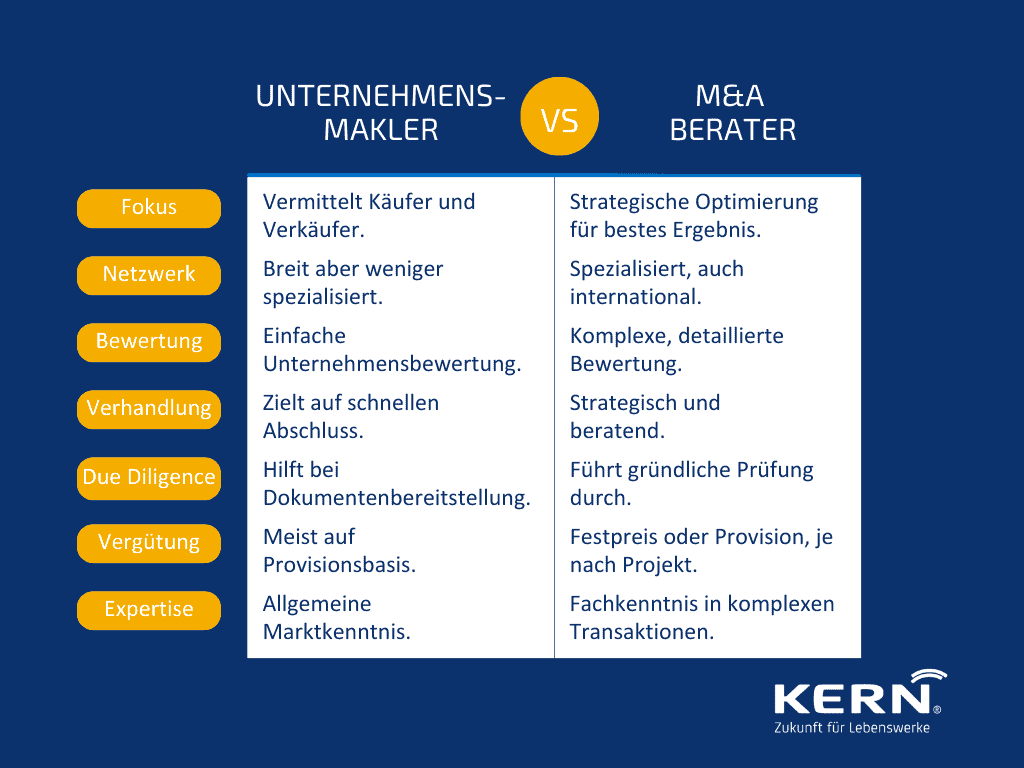
Distinction from a specialised M&A advisor
The world of business sales can be confusing with various technical and expert terms. One of the most common sources of confusion is the distinction between a business broker and a specialised M&A (Mergers & Acquisitions) advisor.
Although both professionals operate within the transactional world and are closely linked, there are crucial differences in their roles and focus. Here’s how a business broker differentiates from a specialised M&A advisor:
1. intermediary vs. advisor: A business broker primarily acts as an intermediary between buyer and seller. Their role is to find and present suitable buyers. Additionally, they may also act as a moderator between the parties involved, if required.
An M&A consultant, on the other hand, is a full-service provider, focusing on providing strategic recommendations even during the preparation phase in order to optimise the entire M&A process beforehand. While the business broker drives the transaction forward, the M&A consultant offers a comprehensive package that often begins with an analysis, continues with a qualified company valuation, and perfectly concludes the preparations for a sales process with a prospectus and neutral teasers. Then the crucial sales phase begins.
2. specialisation: A business broker specialises in facilitating the sale of companies. They have an understanding of the process and typically possess an extensive network of potential buyers.
A specialist M&A advisor, on the other hand, can focus on a broader range of M&A activities, including Fusionen, mergers and acquisitions, capital raising, and strategic advisory. This means that M&A consultants typically offer a broader selection of services and are process consultants in depth.
3. Focus on Transaction Execution The main focus of a business broker is the successful facilitation of the company sale. They work with the parties involved to ensure that the sale runs smoothly.
A specialised M&A advisor, on the other hand, can adopt a strategic role that extends far beyond mere transaction execution. They assist in identifying opportunities, valuing companies, and developing M&A strategies. They are a coach, facilitator, mediator, and “interpreter” as well as an advisor, all in one.
4. Complementary Services: It is important to note that business brokers and M&A advisors are not necessarily mutually exclusive. In fact, in many cases, they can work together to achieve the best possible outcome for the client.
For example, a business broker might involve an M&A advisor to provide strategic advantages for the sale process. This collaboration can help to optimise the entire M&A process, but it is rather uncommon.
Remuneration via fixed price or commission?
When selecting a business broker or M&A advisor to assist with the sale of a company, consideration must be given not only to which expert best suits the specific needs but also to how the services of these professionals should be remunerated. The question of remuneration, whether via a fixed fee or a commission, is of crucial importance and should be carefully weighed. Here, we take a look at the pros and cons of both remuneration models:
Fixed price:
Remuneration via a fixed price is a clear and predetermined payment to the selected expert, regardless of the outcome of the transaction. Let’s assume a fixed price of €30,000 was set to engage the services. Regardless of whether the company is ultimately sold for €0.5 million or €1 million, the remuneration remains the same. This model has its own advantages:
- Transparency: From the outset, it is precisely known how much the services will cost, which allows for better budget planning and, depending on the scope of the services and duration, the seller is on the safe side.
- No conflict of interest: As the remuneration is independent of the sales result, there is no conflict of interest between the customer and the service provider. The incentive to achieve the best price for the company may not be quite as strong as with a success-based model.
Commission:
Remuneration in the form of a commission means that the expert receives a percentage of the sale price. Let’s imagine the company is sold for 2 million euros, and the service provider receives a commission of 5 % of the sale price, which amounts to 100,000 euros. In this case, the remuneration depends directly on a successful sale. This model also has its own advantages:
- Performance incentive: The expert has a strong incentive to achieve the highest possible selling price for the company, as their remuneration is directly dependent on this price.
- Lower financial risk: Payment is only made if the sale actually goes through, which reduces the financial risk should the transaction fail for any reason.
- Expertise evidence: If advisors or brokers are willing to work on a commission-only basis, this may indicate confidence in a successful transaction, or it may indicate strong pressure from the broker to succeed.
Mixed forms of fixed price and commission:
For sellers of companies, this model is particularly reliable and safe. The individual steps in the entire sales process are priced in advance and only invoiced when a proper partial delivery of the promised service has been made.
Additionally, if successful, the expert receives a commission and then deducts the advance costs from the commission (there is often a minimum commission as a lower limit).
This way, the seller does not pay twice and can fairly and transparently track success with their expert in payment upon achievement of targets.
Utilise our company value assessment from over 2,000 company valuations.
In vielen Fällen ist die Wahl eines M&A-Beraters vorteilhafter, weil sie Spezialwissen, Erfahrung und Zugang zu einem breiteren Netzwerk mitbringen. Sie können den Prozess einer Fusion oder Übernahme navigieren, was für Unternehmen, die dies nicht routinemässig tun, komplex und zeitaufwendig sein kann. M&A-Berater können auch dabei helfen, den wahren Wert eines Unternehmens zu ermitteln, potenzielle Käufer oder Verkäufer zu identifizieren und die bestmöglichen Konditionen auszuhandeln. Ausserdem können sie bei der Bewältigung der rechtlichen und finanziellen Aspekte einer Transaktion helfen und sicherstellen, dass alle Vorschriften eingehalten werden.
When undertaking the complex task of selling a company, choosing the right specialist is paramount. In this regard, the question arises: when and why might hiring an M&A advisor be a better choice compared to other options such as business brokers or a DIY sale? This consideration requires a detailed analysis of the specific requirements and objectives of a company sale, and it becomes clear that M&A advisors can play an advantageous role in many cases.
Specialised expertise: M&A advisors specialise in the complex nuances of mergers and acquisitions. Their comprehensive knowledge of the M&A market, their ability to identify potential buyers or sellers, and their strategic approach to the entire transaction process are valuable resources. This expertise can help create optimal conditions and opportunities.
Objectivity and independence: M&A advisors typically operate independently and objectively, without being involved in conflicts of interest. This impartiality allows them to act in the best interests of the client and focus on achieving the best outcomes. This is in contrast to potential conflicts of interest that could arise with other remuneration structures.
Strategic advice: M&A advisors often offer far more than pure transaction services. They can provide strategic advice and analyses to ensure that the sale process aligns with the company’s long-term objectives. This additional perspective can make the difference between a simple sale and a strategically valuable transaction.
The choice of an M&A advisor is not always the only option, and the individual requirements for selling a company can vary. Nevertheless, a detailed analysis shows that specialised expertise, independence and strategic advice can create clear added value for the company in many cases. However, the decision should always be based on a thorough evaluation of the company’s specific needs and goals.
Pitfalls that can be avoided by choosing an expert advisor
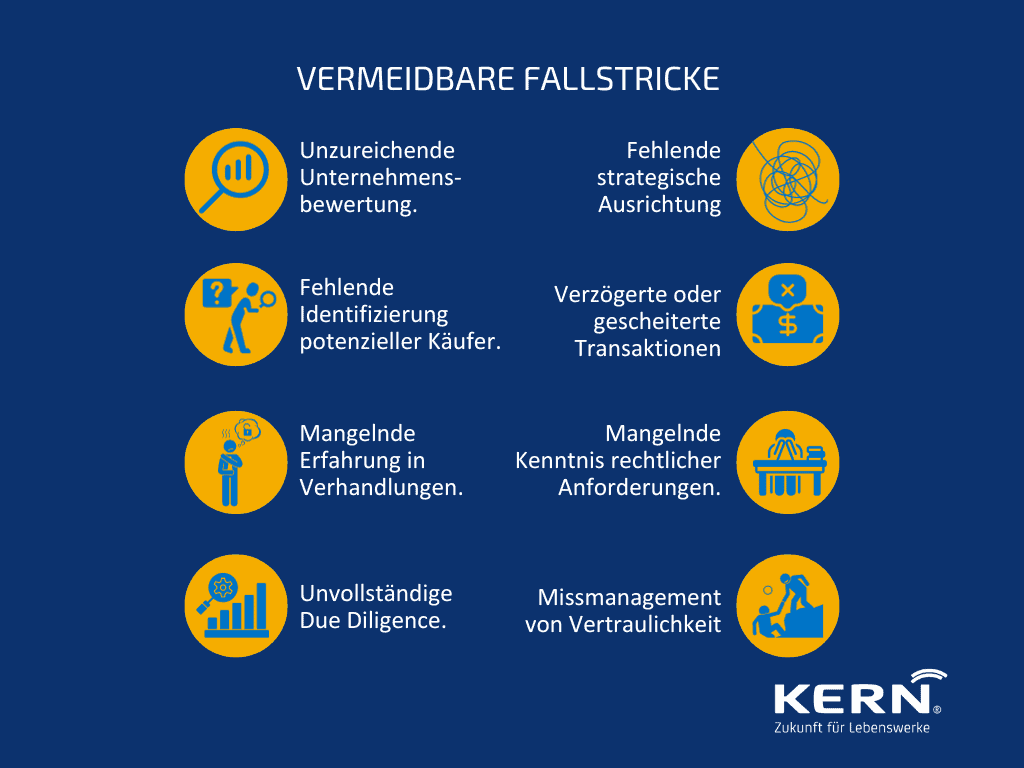
1. inadequate company valuation: The accurate valuation of your company is crucial for setting an appropriate selling price. An M&A advisor has the knowledge and resources to carry out a well-founded valuation, thereby ensuring that your company is offered at a realistic market price.
2. Missing identification of potential buyers: Finding suitable buyers can be a challenge. M&A advisors have an extensive network and can specifically identify and approach potential buyers, including strategic investors and private equity firms. The key is in the pre-selection, and not just any interested party will be presented. This could even pose a security risk.
3. lack of experience in negotiations: Negotiations concerning the sale price and contractual terms require expertise and experience. An M&A advisor specialises in successfully conducting negotiations and ensuring your interests are protected.
4. Incomplete Due Diligence Thorough due diligence is crucial for identifying potential risks and issues before it’s too late. M&A advisors assist in providing documents and information to ensure that due diligence proceeds smoothly.
5. lack of knowledge of legal requirements: The legal framework for company sales can be complex. An M&A advisor works closely with lawyers to ensure all legal requirements are met and the sales process runs smoothly.
6. Delayed or Failed Transactions: Without experienced leadership, transactions can falter or even fail. An M&A advisor specialises in overcoming obstacles and ensuring the transaction’s completion. Furthermore, they can ultimately secure a better price, thereby even neutralising their costs for the seller.
7. lack of strategic direction: A successful company sale should align with the company’s long-term objectives. An M&A advisor offers strategic consultancy to ensure the sale process supports the company’s long-term vision.
8. mismanagement of confidentiality: Maintaining confidentiality is crucial to sustain business operations during the sale process. M&A advisors have established best practices to preserve confidentiality and protect information from unintended leaks.
Mixed forms of sales consultants
In the realm of business sales, there is no one-size-fits-all solution, as the requirements of companies can vary. Hybrid sales advisory models are flexible and adaptable approaches that combine various services to create bespoke solutions for clients. These hybrid models can bring together elements of business brokers, M&A advisors, and other professionals. Examples of hybrid models include:
- Advice from M&A advisors with a commission-based approach: Here, an M&A advisor offers strategic advice and transaction support, retaining an incentive through a portion of their remuneration being tied to the successful completion of the transaction.
- Business broker with extended services: Some business brokers offer additional services, such as due diligence support or strategic advice, to provide more comprehensive assistance to their clients.
- Transaction advisor with a long-term focus: These consultants develop long-term relationships with their clients, working not just on individual transactions but also on long-term strategic goals, such as identifying acquisition opportunities.
Conclusion
A business broker and a specialised M&A advisor play different but crucial roles in the company sale process. The broker primarily acts as a business intermediary, focusing on transaction execution. M&A advisors, on the other hand, bring in-depth expertise and strategic advice to the process to achieve optimal results in an all-inclusive package.
The choice of remuneration structure, whether fixed price or commission, depends on individual preferences, budget, and business objectives. For more complex sales processes, engaging an M&A advisor may be more advantageous, as they offer comprehensive support not only with valuation and buyer identification but also with negotiations, due diligence, and legal requirements.


FAQ – The most frequent questions
What does a business broker do?
A business broker is an expert who specialises in bringing together buyers and sellers of businesses, aiming to bring the two parties to a conclusion as quickly as possible.
What does M&A consulting mean?
M&A consulting stands for „Mergers & Acquisitions Advisory“ and refers to the professional support and consultancy that companies receive when undertaking mergers, acquisitions, or divestiture processes. M&A advisors offer considered expertise, assist in identifying M&A opportunities, conduct due diligence reviews, and guide the entire transaction process as a sparring partner and advisor alongside the seller.
How to sell a company?
To sell a company, various steps need to be taken, including valuing the business, identifying potential buyers, negotiating the sale price and contract terms, conducting thorough due diligence, and finalising the sale agreement. The assistance of business brokers or M&A advisors can facilitate the process and ensure it is completed successfully.
